WHO said you need 20% down?
WAIT. WHO TOLD YOU THAT YOU NEED 20% DOWN?
Because we need to have a little chat.
Jenny Jones, The Jones Team at Baird & Warner | 7 min read | Last reviewed: September 2026

The Short Version
No, 20% is not a universal down-payment requirement.
Depending on the borrower, property and loan program, qualified buyers may have options requiring substantially less—and certain VA and USDA borrowers may have zero-down-payment options.
But the smallest possible down payment isn’t automatically the best choice.
Somewhere along the way, 20% became the number.
The number renters hear.
The number future buyers panic over.
The number that can make buying a home feel approximately 147 years away.
Take a $350,000 house.
Twenty percent down is $70,000.
And if your immediate reaction is:
“Well. Guess I’ll just keep renting until I’m 93.”
Fair.
Except there’s one fairly important detail:
You may not need 20% down at all.
Depending on the buyer, the property and the loan program, the down payment could be considerably smaller.
For some qualified buyers?
It could even be zero.
So before we let one giant number murder your future-home plans, let’s figure out where this 20% business came from—and what your options could actually look like.
So Why Does Everyone Keep Talking About 20%?
Because 20% isn’t a completely random number somebody pulled out of a mortgage-themed hat.
With many conventional mortgages, putting less than 20% down typically means you’ll pay private mortgage insurance (PMI).
PMI protects the lender if the borrower stops making payments, and its cost is generally added to your monthly housing expense.
Put 20% down on a conventional mortgage, and PMI generally isn’t required.
So yes—there can be real advantages to putting 20% down.
But somewhere along the way...
“There are advantages to putting 20% down”
turned into...
“You HAVE to put 20% down.”
Those are two very different sentences.
And Future Homeowner You deserves the correct one.
What Could a Down Payment Actually Look Like?
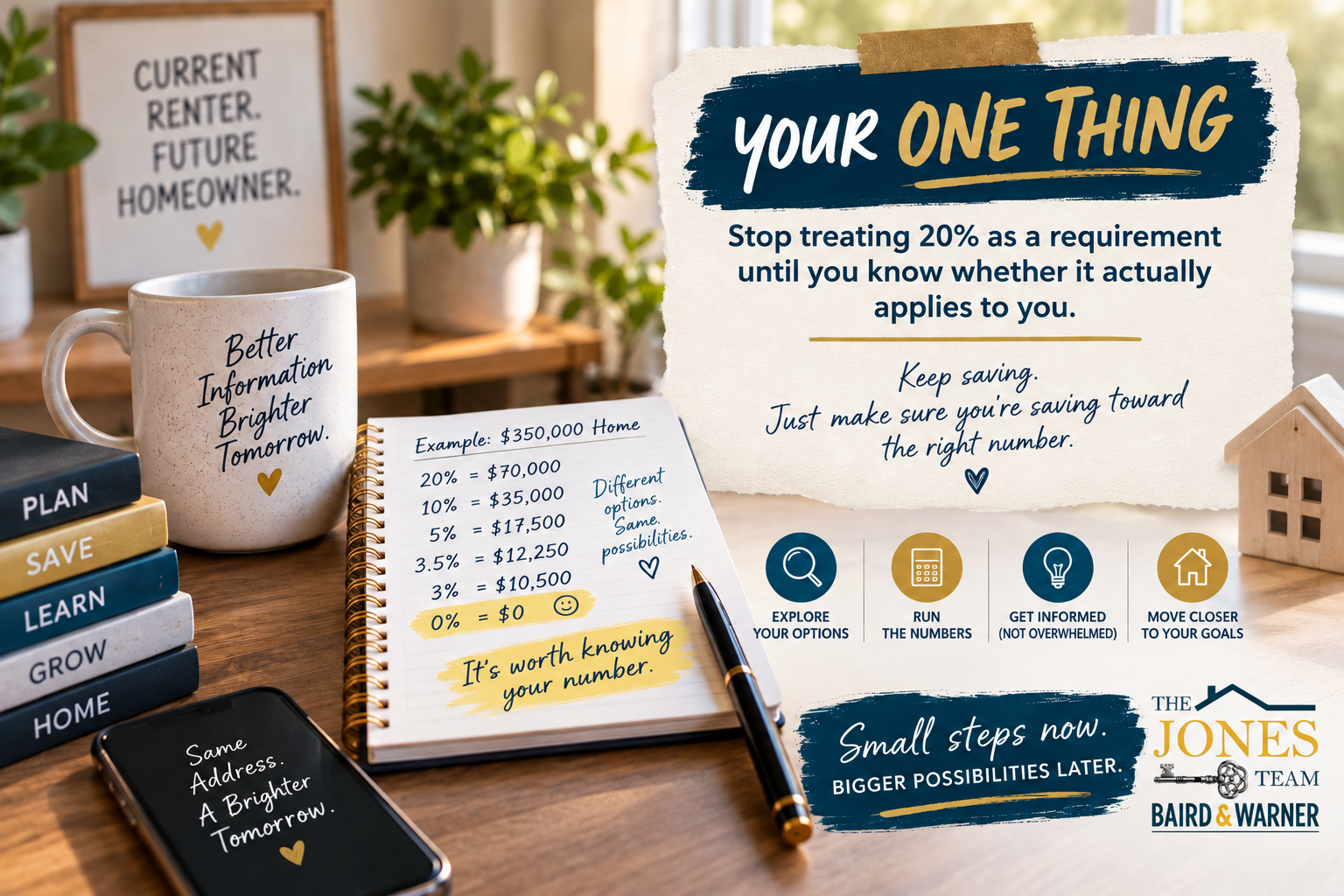
Let’s use that same hypothetical $350,000 home.
Hypothetical $350,000 home
Down payment
20%
$70,000
Down payment
10%
$35,000
Down payment
5%
$17,500
Down payment
3.5%
$12,250
Down payment
3%
$10,500
Well.
That’s a considerably different collection of numbers.
Now, before anybody sees $10,500 and starts favoriting houses during lunch...
This does not mean everyone can—or should—buy a $350,000 home with 3% down.
The point is much simpler:
The percentage dramatically changes the savings target.
And depending on the financing you qualify for, your minimum required down payment could look very different from the 20% you’ve been assuming.
Yes, Lower-Down-Payment—and Even Zero-Down—Mortgages Really Exist
This isn’t REALTOR folklore.
There are legitimate mortgage programs that allow qualified buyers to purchase with considerably less than 20% down.
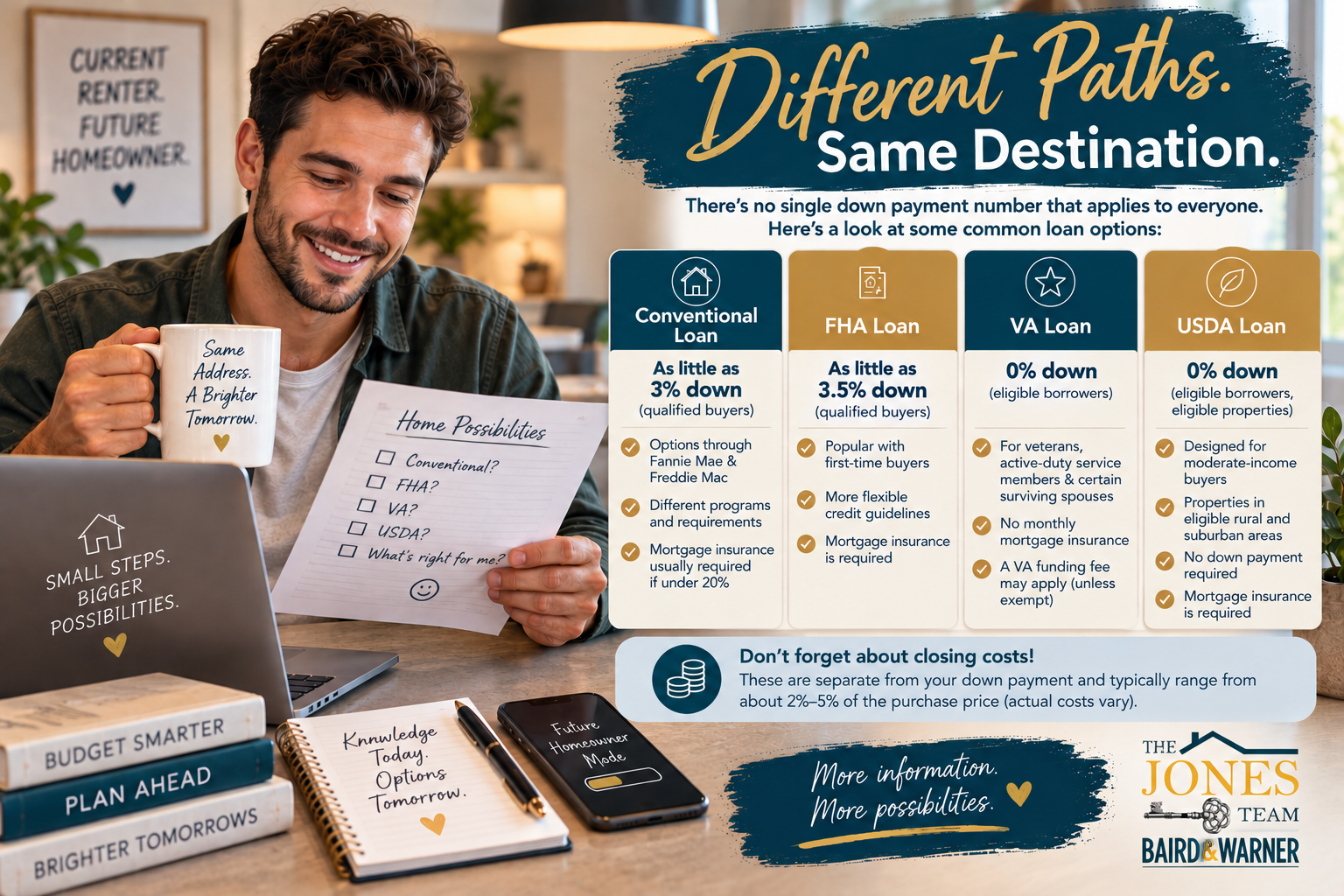
Conventional Loans
Some conventional financing options through Fannie Mae and Freddie Mac allow qualified borrowers to purchase with as little as 3% down.
Different programs have different eligibility requirements, so 3% conventional isn’t automatically available to every borrower or every situation.
But yes.
Three percent is a real thing.
FHA Loans
For qualified borrowers, FHA financing can allow a minimum down payment of 3.5%.
FHA loans have their own qualification requirements and mortgage-insurance structure, so we’re not declaring FHA the winner of some imaginary mortgage beauty pageant.
We’re simply establishing that:
20% isn’t the starting line for every loan.
VA Loans
For eligible veterans, active-duty service members and certain surviving spouses, VA-backed home loans can offer financing with no required down payment.
VA loans also generally don’t require monthly private mortgage insurance, although a VA funding fee may apply unless the borrower qualifies for an exemption.
So if someone is VA-eligible, assuming they need to save 20% before they can even explore buying a home could be wildly different from the financing options actually available to them.
That’s information worth knowing.
USDA Loans
USDA financing can also provide 100% financing—with no down payment required—for eligible borrowers purchasing eligible properties.
And this one is especially worth talking about because people hear “USDA” and immediately picture:
farm + tractor + approximately 47 chickens.
Not necessarily.
USDA eligibility considers things including household income and the location of the property. Eligible areas can include communities outside major urban centers that you may not personally think of as particularly “rural.”
So don’t automatically eliminate USDA because you have no intention of purchasing livestock.
The chickens are optional.
So What’s the “Right” Down Payment?
Here’s the annoying—but responsible—answer:
It depends.
Your financing options can depend on things like:
- ◆the loan program,
- ◆your credit profile,
- ◆your income and debts,
- ◆property eligibility,
- ◆occupancy,
- ◆purchase price,
- ◆available savings,
- ◆and other underwriting requirements.
Which means one future buyer’s answer might be:
0%
Another’s might be:
3%3.5%5%10%20%
Or something else entirely.
There is no single magical down-payment number that applies to everybody.
And that’s really the point of this entire conversation.
But Smaller Isn’t Automatically Better
Now we’re going to keep the pendulum from swinging completely in the other direction.
If 3% is allowed, does that mean you should put 3% down?
Not necessarily.
A larger down payment can potentially:
- ◆reduce the amount you’re borrowing,
- ◆lower your monthly principal-and-interest payment,
- ◆reduce or eliminate certain mortgage-insurance costs,
- ◆and leave you with more equity in the home from day one.
Those are legitimate benefits.
But putting every available dollar into your down payment isn’t automatically brilliant either.
Because after closing...
you still have to live there.
And houses occasionally enjoy introducing themselves with things like:
Hello. I’m your water heater. We’ve never met, but I’ve chosen violence.
Having money left in savings matters.
So the goal isn’t:
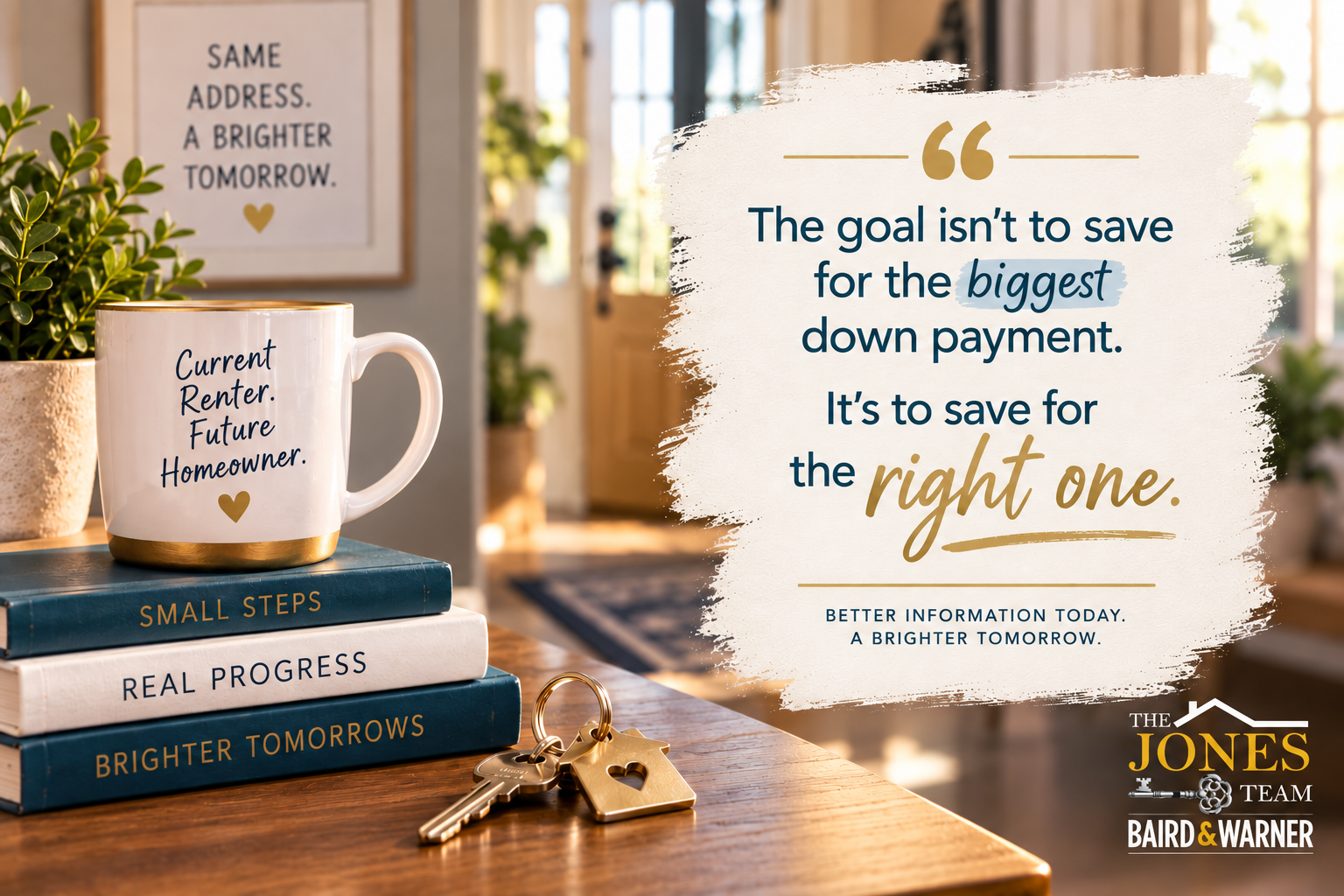
“How can I possibly scrape together the biggest down payment?”
It’s:
“What down payment makes sense for my loan, my monthly budget and my overall financial situation?”
Very different question.
Much better question.
And Don’t Forget About the OTHER Money
Here’s another place future buyers get tripped up:
Your down payment and your total cash needed to buy are not necessarily the same number.
There can also be closing costs and other upfront expenses associated with purchasing a home.
Freddie Mac currently estimates closing costs at roughly 2%–5% of the purchase price, although actual costs vary based on the loan and transaction.
There may also be expenses such as inspections, moving costs and the very glamorous realization that you suddenly own 14 windows and approximately zero curtains.
So I don’t want Future Homeowner You simply replacing one bad assumption with another.
Don’t go from:
“I need 20%.”
to:
“Sweet! I only need 3%.”
Instead, start asking:
“What would MY realistic cash-to-close target actually look like?”
Now we’re getting somewhere.
Where People Get Tripped Up
“I don’t have 20%, so I can’t afford to buy.”
Maybe.
Maybe not.
Not having 20% saved does not, by itself, tell us whether you’re financially ready to purchase a home.
“If I qualify for the minimum down payment, that’s obviously what I should do.”
Also nope.
The smallest allowable down payment isn’t automatically the smartest financial strategy.
There are tradeoffs.
“PMI means I’m doing something wrong.”
No.
Mortgage insurance is simply part of how certain mortgage programs manage risk when a borrower puts less money down.
And different loan programs handle mortgage insurance differently.
It is a cost to understand and evaluate, not a scarlet letter pinned to your mortgage application.
“Once I’ve saved my down payment, I’m ready.”
Easy there, Future Homeowner.
Your down payment is only one piece of the financial puzzle.
What This Doesn’t Mean
Learning that you might not need 20% down does not mean you should immediately run out and buy a house.
- ✗It doesn’t mean everyone qualifies for low- or zero-down-payment financing.
- ✗It doesn’t mean the smallest possible down payment is automatically best.
- ✗And it definitely doesn’t mean you should stop saving.
Actually...
Keep saving.
Just make sure you’re eventually saving toward the right number.
Because there’s a huge difference between intentionally building a future-home fund and blindly chasing a $70,000 target somebody told you was mandatory.
If you’ve been using 20% as your automatic homebuying savings goal...
Stop treating it like a requirement until you know whether it actually applies to you.
You don’t need to choose a loan today.
You don’t need to get preapproved today.
You don’t even need to know when you’ll buy.
We’re simply replacing an assumption with better information.
That’s progress.
Time required: approximately 30 seconds. Assumptions replaced: one.
Future Homeowner Homework
Grab your phone calculator.
Seriously. This will take about two minutes.
Pick a pretend future home price.
Choose something that feels reasonably possible someday.
No commitment. We’re playing with numbers.
Calculate these five amounts:
20%10%5%3.5%3%
Write them down.
Look at how different those numbers are.
And if you think you might qualify for VA or USDA financing, add a big fat:
0%
to the list too.
Then write down ONE question:
“What would MY realistic cash-to-close target actually be?”
You don’t need the answer today.
For now, knowing that there is an answer—and that it may look very different from the number you’ve been carrying around in your head—is enough.
Current Renter. Future Homeowner.
You don’t have to be ready to buy a house to start getting smarter about buying one.
That’s exactly what the Future Homeowner Plan is about.
Small steps.
Better information.
Fewer weird mortgage assumptions living rent-free in your head.
And eventually, when the time is right, you’ll already understand a whole lot more than you did when you started.
Same address. A brighter tomorrow. ♥
Not ready to buy yet? Perfect. You don’t need to be.
The Future Homeowner Plan is about figuring out what “ready” could eventually look like—before you’re standing there trying to figure everything out at once.
Want help figuring out what your future-home numbers might look like? Start a Future Homeowner conversation with the Jones Team. No house hunting required.
Explore the Future Homeowner Plan →Down Payment FAQ
Do you really need 20% down to buy a house?
No. Twenty percent is not a universal requirement. Qualified borrowers may have conventional, FHA, VA or USDA options requiring less.
Can you buy a house with 3% down?
Some conventional mortgage programs allow qualified borrowers to purchase with as little as 3% down.
How much down do you need for an FHA loan?
Qualified FHA borrowers may be eligible for a minimum down payment of 3.5%, subject to FHA requirements.
Can you buy a house with zero down?
Potentially. Eligible VA borrowers and qualifying USDA borrowers purchasing eligible properties may have zero-down-payment financing options.
What happens if you don’t put 20% down?
It depends on the loan. With many conventional mortgages, putting less than 20% down generally means PMI is required. Other loan programs have different mortgage-insurance or fee structures.
Are closing costs included in the down payment?
No. The down payment and closing costs are separate components of cash needed for a purchase. Actual closing costs vary by transaction.
Keep going in the Future Homeowner Plan
◆Article 1: Your Rent Could Actually Help Your Credit
◆Article 3: What Credit Score Do You REALLY Need? (coming next)
Educational Note: Mortgage programs, qualification requirements, rates, fees and guidelines can change and vary by borrower, property and lender. This article is for general educational purposes and is not financial, lending, tax or legal advice. A qualified mortgage professional can help determine which financing options may apply to your specific situation.
About The Jones Team
The Jones Team at Baird & Warner Algonquin helps buyers, sellers and future homeowners throughout Chicago’s northwest suburbs and Fox River Valley understand real estate without the jargon, pressure or nonsense. Led by Jenny Jones, a REALTOR® with more than 20 years of experience, the team believes becoming a smart homeowner starts long before you get the keys.
The Future Homeowner Plan was created to help today’s renters understand and prepare for tomorrow’s homeownership—one manageable step at a time.
Sources
- Consumer Financial Protection Bureau (CFPB) — conventional loans and private mortgage insurance (PMI)
- Fannie Mae — low-down-payment conventional options
- Freddie Mac — low-down-payment programs and estimated closing costs
- HUD / FHA — FHA minimum required investment
- U.S. Department of Veterans Affairs — VA home-loan down-payment, mortgage-insurance and funding-fee guidance
- USDA Rural Development — Single Family Housing Guaranteed Loan Program / 100% financing
Last reviewed for program accuracy: September 2026
Educational Note: Mortgage programs, underwriting requirements, interest rates and lender
guidelines can change and may vary based on the borrower, property, loan program and
lender. This article is intended for general educational purposes and is not financial, credit,
lending or legal advice. A licensed mortgage professional can evaluate your individual
circumstances and current financing options.
Categories
Recent Posts